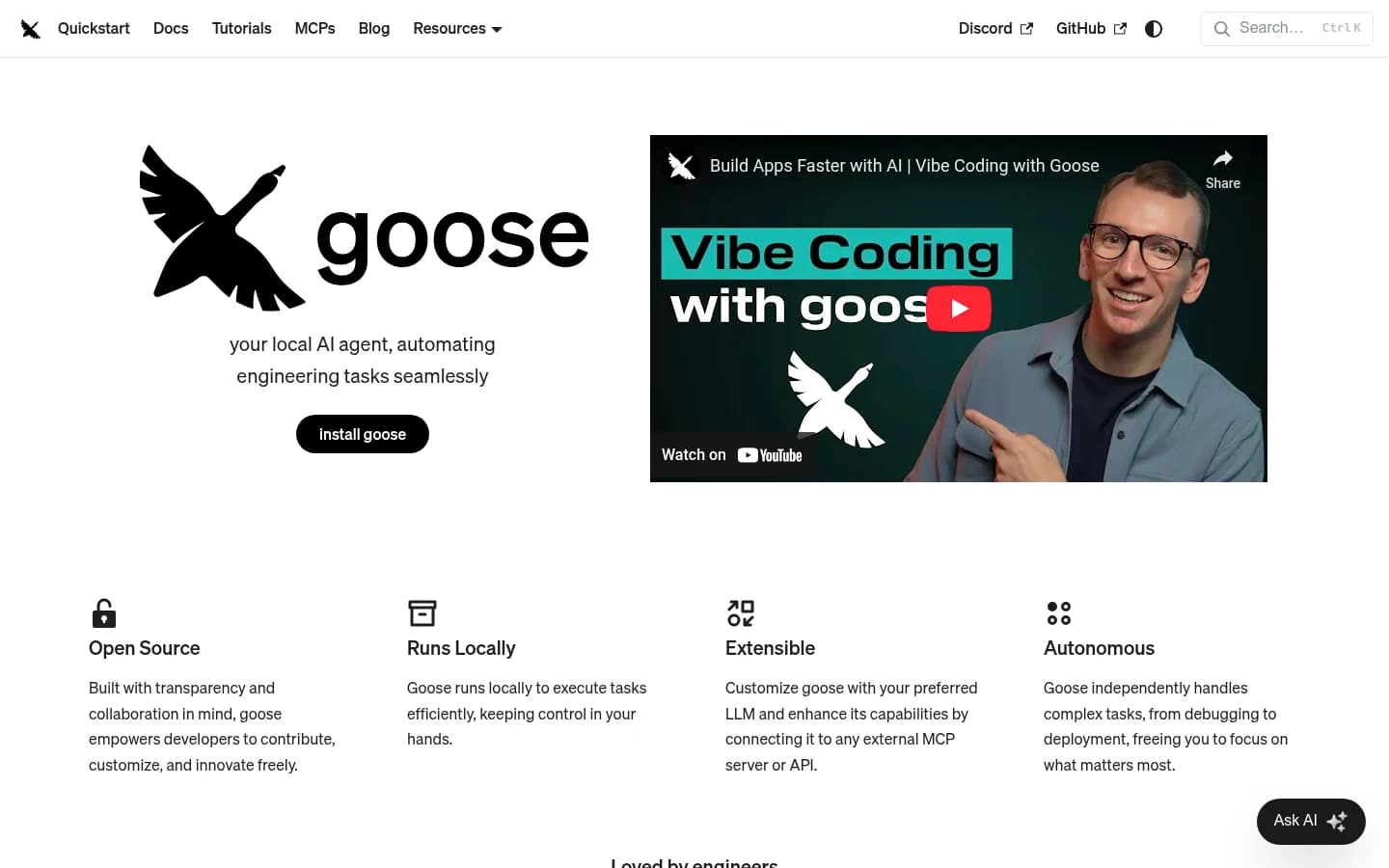
Goose is an industrial-strength open source AI agent developed by Block (formerly Square). Unlike standard coding assistants (like Copilot or ChatGPT) that simply suggest code snippets, Goose acts as a virtual senior engineer sitting at your terminal.
The Core Problem: Most AI tools are passive. You copy code, paste it into your editor, debug errors, and repeat. This "human-in-the-loop" friction limits productivity for complex refactors or multi-file changes.
The Goose Solution: Goose connects directly to your shell and IDE. It plans a solution, executes terminal commands, edits files, runs tests to verify its work, and iterates on errors—autonomously. It leverages the Model Context Protocol (MCP) to plug into any tool, effectively turning natural language into executable engineering work.
Key Features#
- Model Agnostic Intelligence: Break free from vendor lock-in. Configure Goose to run with Claude 3.5 Sonnet, GPT-4o, Gemini, or local open-source models (via Ollama). You control the brain; Goose provides the hands.
- Autonomous Agentic Loop: Goose doesn't just write code; it self-corrects. If a build fails or a test errors out, Goose reads the output, diagnoses the issue, and applies a fix without your intervention.
- Model Context Protocol (MCP) Support: Built on Anthropic's open standard, Goose can be extended with "skills." Connect it to Google Drive, Slack, PostgreSQL, or custom internal APIs to give it context beyond your codebase.
- Dual Interface: Use the robust CLI for headless tasks and server environments, or the Electron-based Desktop App for a visual, interactive experience with rich diff views.
- Project-Specific "Hints": Create a
.goosehints file to teach Goose your repository's specific architectural patterns, coding standards, and "gotchas," ensuring generated code matches your team's style.
- Secure & Local-First: Goose runs entirely on your machine. Your code never leaves your local environment unless you explicitly configure a cloud-based LLM provider.
Architecture & Tech Stack#
Goose is engineered for performance and safety, utilizing a modular architecture that separates the brain (LLM) from the body (Execution Engine).
- Core Runtime (Rust): The heart of Goose is written in Rust, ensuring memory safety and blazing-fast execution. This binary handles the agentic loop, file system operations, and terminal management.
- Extension System (MCP): Tools are implemented as MCP Servers. When you ask Goose to "check the database," it communicates with a distinct Postgres MCP server via standard JSON-RPC messages. This decouples the core agent from specific tool implementations.
- Context Window Management: Goose employs intelligent token management strategies. It summarizes past interactions and prunes irrelevant context to keep the LLM focused and costs low, preventing "context drift" in long sessions.
- Frontend: The desktop experience is built with Electron and React, providing a bridge between the Rust backend and a user-friendly chat interface.
Pros and Cons#
Pros
- Total Control: You own the stack. Swap models instantly if a cheaper or smarter one comes out.
- Real Automation: Can handle multi-step tasks like "migrate this entire module from Python 2 to 3" with minimal supervision.
- Ecosystem Friendly: Standardizing on MCP means you can use tools built for Claude or other agents.
- Developer Experience: The "Goose Hints" feature drastically reduces the need for repetitive prompting about coding styles.
Cons
- Token Costs: Autonomous loops can burn through API credits quickly if the agent gets stuck in a loop.
- Setup Friction: Requires more initial configuration (API keys, tool installations) compared to "one-click" paid products like Cursor.
- Maturity: As a newer project, it may have more edge-case bugs than established enterprise tools.
Getting Started#
Installation is simple via a single shell script. You will need an API key from a provider like OpenAI, Anthropic, or OpenRouter.
# 1. Install Goose (Mac/Linux)
curl -fsSL https://github.com/block/goose/releases/download/stable/download_cli.sh | bash

# 2. Configure your LLM provider
# Follow the interactive prompts to set your API key
goose configure

# 3. Start the agent
goose session

# 4. Give your first command
# "Analyze the current directory and create a README.md describing the project structure."
Conclusion#
Goose represents the future of the open source AI agent. It stops treating AI as a chatbot and starts treating it as a digital employee. By combining the flexibility of the Model Context Protocol with a rugged, developer-first CLI, it empowers you to build faster and automate the boring parts of engineering. If you are ready to move beyond auto-complete, it is time to let the Goose loose.